
03.1 – Introductory description
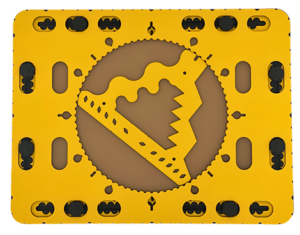
The size of the ZigzagTriangle is such that it fits exactly inside the 20- centimetre diameter of the circle. The three sides of the body of the triangle have different patterns. The middle section of the triangle is open. The inner sides have the same patterns at a smaller scale as those along the outside. The ZigzagTriangle is also called a ‘Christmas tree’.
To description section
To manual section
03.2 – Detailed description
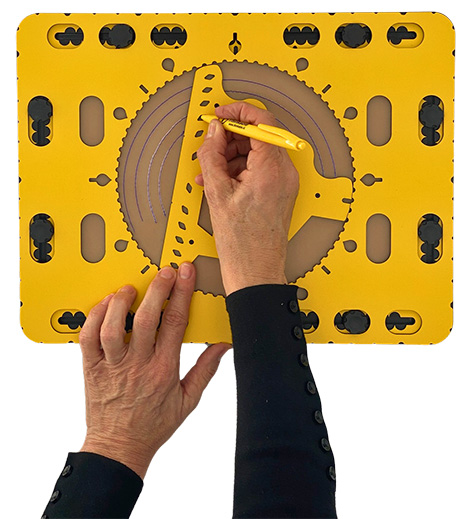
The corners of the triangle are rounded. One corner has an alignment indentation to align the triangle with the degree markings along the edge of the circle. The side opposite the indented corner is straight. Another provides a smooth wave pattern and the final side has a zigzag pattern. Along the inner and outer side of the straight side, two small indents indicate the length of a line segment to construct a hexagon. In the straight side, oval holes can be found to hold a pen while rotating the triangle. The holes are placed to obtain curves at four, five, six, seven, eight or nine centimetres relative to the centre of the circle. Pushpin markers are placed near the corners.
03.3 – ZigzagTriangle manual
03.4 – Preparing the TactiPad
Place all eight knobs of the TactiPad approximately five centimetres away from the corners. Place the circle frame on top of the TactiPad.
03.5 – Using the ZigzagTriangle
The ZigzagTriangle fits exactly inside the circle, with the rounded corners nearly touching the circle edge. It can rotate freely. Place your pointing finger on the alignment indent and align the triangle at 12 o’clock. Now you can create an equilateral triangle inside the circle. Start with the indented corner at 12o’clock and draw along the straight outside edge of the triangle. Rotate the tool by 120 degrees clockwise (which is at 4 o’clock) and draw the line. Rotate once more by 120 degrees (which is at 8 o’clock).
03.6 – Hexagon in the circle
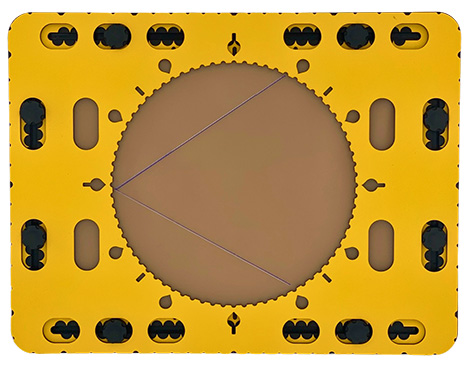
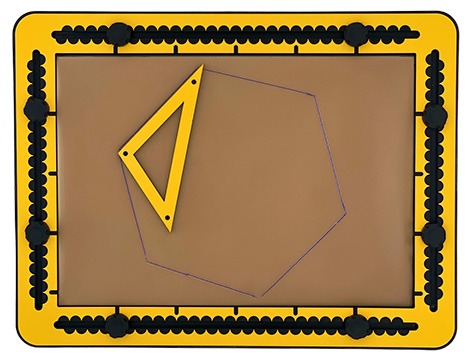
Align the indented corner at any degree indication and draw a line only between the two indents along the inner or outer straight side. Rotate the triangle 60 degrees and repeat the drawing. In total, four more rotations are required to finish the shape.
03.7 – Repetitive patterns; Mandala type of figures
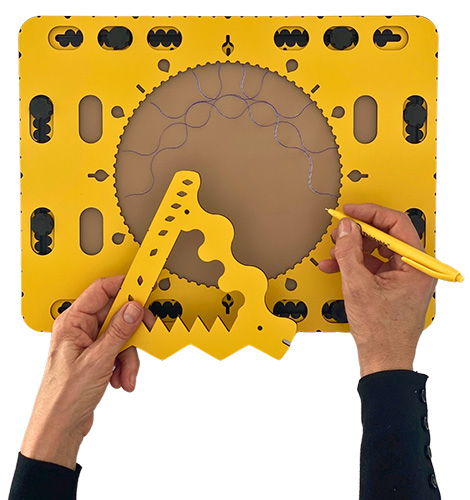
By tracing segments of the sides and/or combining patterns, intriguing drawings will emerge. Whatever you do, the result is fascinating.
03.8 – Oval holes to create arches
The holes in the straight side of the triangle can hold a pen. Rotate the triangle holding the pen. Arches with a length depending on the amount of rotation and the selected radius will be created.
 Back to top of page
 Previous section
