
array( 'next' => 'Next section', 'prev' => 'Previous section', 'next_default' => 'This is the last section', 'prev_default' => 'This is the first section' ), 'it' => array( 'next' => 'Sezione successiva', 'prev' => 'Sezione precedente', 'next_default' => 'Questa è l\'ultima sezione', 'prev_default' => 'Questa è la prima sezione' ) ); $labels = isset($labels[$lang]) ? $labels[$lang] : $labels['en']; // Haal posts op in dezelfde categorie, tag en taal $args = array( 'posts_per_page' => -1, 'post_type' => 'post', 'orderby' => 'title', 'order' => 'ASC', 'tag_slug__in' => $tag_slugs, 'category__in' => wp_get_post_categories($post->ID), 'post_status' => 'publish', 'suppress_filters' => false, // WPML filter toepassen 'lang' => $lang // WPML taalfilter ); $posts = get_posts($args); if(empty($posts)) return; // Vind index van huidige post $current_index = null; foreach($posts as $i => $p) { if($p->ID == $post->ID) { $current_index = $i; break; } } if($current_index === null) return; // Bepaal next/previous post if($direction === 'next') { $target_index = $current_index + 1; $text = ($target_index < count($posts)) ? $labels['next'] : $labels['next_default']; } else { $target_index = $current_index - 1; $text = ($target_index >= 0) ? $labels['prev'] : $labels['prev_default']; } $link = ($target_index >= 0 && $target_index < count($posts)) ? get_permalink($posts[$target_index]->ID) : '#'; $icon_position = ($direction === 'prev') ? 'before' : 'after'; echo ''; } /** * Functie: Back to manual links met WPML en meertalige labels */ function back_to_manual_link($page_id, $img_url, $labels) { $lang = defined('ICL_LANGUAGE_CODE') ? ICL_LANGUAGE_CODE : 'en'; $text = isset($labels[$lang]) ? $labels[$lang] : $labels['en']; if(function_exists('icl_object_id')) { $translated_id = apply_filters('wpml_object_id', $page_id, 'page', true); } else { $translated_id = $page_id; } $link = get_permalink($translated_id); echo '
'; echo ''. esc_attr($text) .' '. esc_html($text) .''; echo '
'; } // --- Next/Previous links --- if(has_tag(array('manual-en-2','manuale-it'))) { manual_navigation_by_title('prev', array('manual-en-2','manuale-it'), 'https://thinkable.nl/wp-content/uploads/2018/09/previous.png'); manual_navigation_by_title('next', array('manual-en-2','manuale-it'), 'https://thinkable.nl/wp-content/uploads/2018/09/next.png'); } // --- Back to manual links --- $manual_links = array( 'tvmanualsection-en' => array( 'page_id' => 1515, 'img' => 'https://thinkable.nl/wp-content/uploads/2018/09/up.png', 'labels' => array( 'en' => 'Return to TactileView manual overview', 'it' => 'Torna al manuale TactileView' ) ), 'tpmanualsection-en' => array( 'page_id' => 1996, 'img' => 'https://thinkable.nl/wp-content/uploads/2018/09/up.png', 'labels' => array( 'en' => 'Return to TactiPad manual overview', 'it' => 'Torna al manuale TactiPad' ) ), 'manuale-it' => array( 'page_id' => 1996, 'img' => 'https://thinkable.nl/wp-content/uploads/2018/09/up.png', 'labels' => array( 'en' => 'Return to TactiPad manual overview', 'it' => 'Torna al manuale TactiPad' ) ), 'circleframe-en' => array( 'url' => 'https://thinkable.nl/tactipad/circleframe-manual', 'img' => 'https://thinkable.nl/wp-content/uploads/2018/09/up.png', 'labels' => array( 'en' => 'Return to CircleFrame manual overview', 'it' => 'Torna al manuale CircleFrame' ) ), 'graphgrid-en' => array( 'url' => 'https://thinkable.nl/tactipad/graphgrid-manual', 'img' => 'https://thinkable.nl/wp-content/uploads/2018/09/up.png', 'labels' => array( 'en' => 'Return to GraphGrid manual overview', 'it' => 'Torna al manuale GraphGrid' ) ), 'graphgrid-manual-en' => array( 'url' => 'https://thinkable.nl/tactipad/graphgrid-manual', 'img' => 'https://thinkable.nl/wp-content/uploads/2018/09/up.png', 'labels' => array( 'en' => 'Return to GraphGrid manual overview', 'it' => 'Torna al manuale GraphGrid' ) ), 'graphgrid-tools-en' => array( 'url' => 'https://thinkable.nl/tactipad/graphgrid/', 'img' => 'https://thinkable.nl/wp-content/uploads/2018/09/up.png', 'labels' => array( 'en' => 'Return to GraphGrid overview', 'it' => 'Torna alla panoramica GraphGrid' ) ), 'tactiforma' => array( 'url' => 'https://thinkable.nl/tactiforma-manual-overview/', 'img' => 'https://thinkable.nl/wp-content/uploads/2018/09/up.png', 'labels' => array( 'en' => 'Return to Tactiforma overview', 'it' => 'Torna alla panoramica Tactiforma' ) ), 'mdamanualsection-en' => array( 'page_id' => 4284, 'img' => 'https://thinkable.nl/wp-content/uploads/2018/09/up.png', 'labels' => array( 'en' => 'Return to MDA manual overview', 'it' => 'Torna al manuale MDA' ) ), ); foreach($manual_links as $tag => $data) { if(has_tag($tag) || has_category($tag)) { if(isset($data['page_id'])) { back_to_manual_link($data['page_id'], $data['img'], $data['labels']); } elseif(isset($data['url'])) { $text = isset($data['labels'][$lang]) ? $data['labels'][$lang] : $data['labels']['en']; echo '
'; echo ''. esc_attr($text) .' '. esc_html($text) .''; echo '
'; } } } ?>

05 Simple bar chart

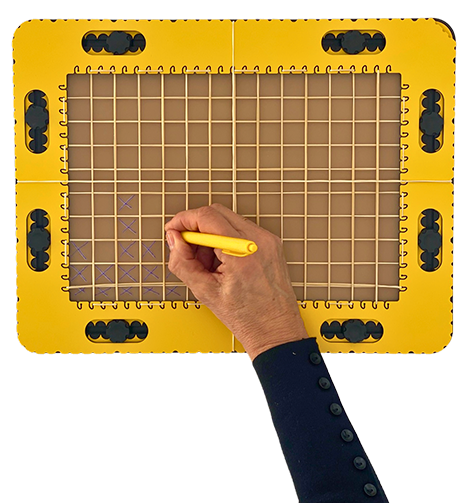
The columns of the GraphGrid frame can be considered as bars of a bar chart. The value in each bar is indicated by the number of marked cells, starting from the lower edge of the frame or from an additional rubber band. The lower edge or the rubber band is the X axis. A cell can stand for one or multiple units or for a percentage.

Photo: GraphGrid on TactiPad with one hand drawing crosses and circle in a tic-tac-toe field in the coordinate system.

Bar chart for birthday data

This bar chart example presents an overview of when people in a group have their birthday spread over the year. Setup: Each column stands for a month. Each cell stands for one person.

Procedure: Ask who has his/her birthday in January and mark the number of cells accordingly. Do the same for all respective months. Take the GraphGrid away. You can now interpret the data by counting the number of markings in the column.
More complex data

One bar can present multiple data by applying different tactile markings in the same cell. For a male count you can apply a line in the cell from lower left to upper right and for female a line from upper left to lower right. Data that are presented with two colours could follow the same routine. Additional graphical markings can present even more complex data types.

Providing maximum value/top of the bar

To present numeric values you can find the position in the column/bar by counting upwards from the X axis. Assume the maximum value can go as high as 1000, than you might take five cells as the longest bar. A value of 700 can be indicated as a straight line horizontally in the middle of the forth cell up. Only the top of the bar needs to be indicated in order to interprete the data.

Item added to cart.
0 items - $0.00